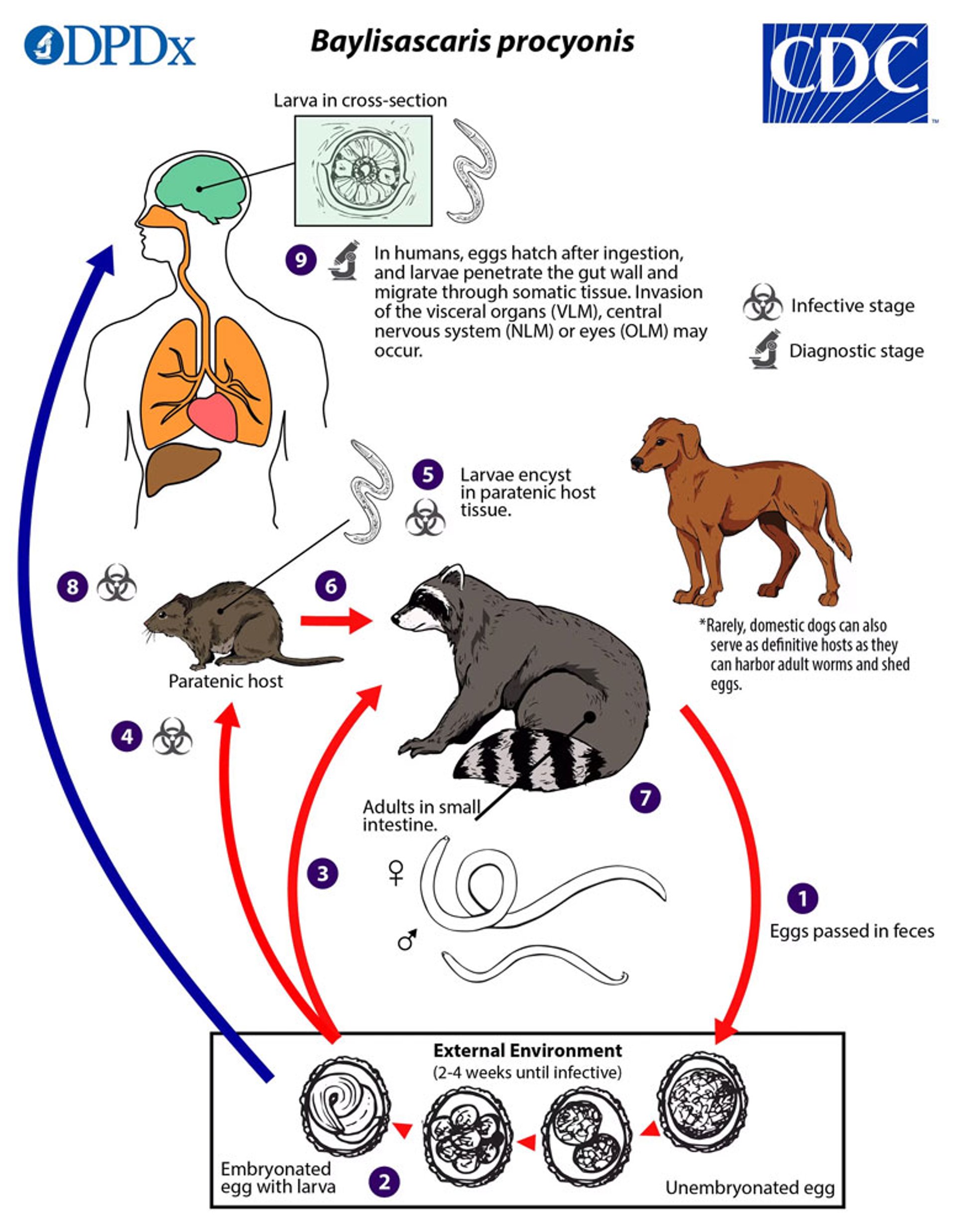
Baylisascaris procyonis Life Cycle
1. Raccoons shed B. procyonis eggs in their feces into the environment.
2. Eggs take 2 to 4 weeks to become infective.
3. In the environment, raccoons can be infected by ingesting infective eggs.
4. Many other animals can be intermediate hosts.
5. The eggs ingested by these hosts hatch into larvae that penetrate the gut wall and migrate through a wide variety of tissues where they encyst.
6. The life cycle is completed when raccoons eat these hosts.
7. The larvae develop into adult worms in a raccoon’s small intestine, and eggs are passed in its feces.
8. Humans become infected when they accidentally ingest infective eggs from the environment. After ingestion by humans, the eggs hatch into larvae.
9. The larvae migrate through a wide variety of human tissues (liver, heart, lungs, brain, eyes) and cause visceral larva migrans (VLM) and ocular larva migrans (OLM) syndromes. Neural larva migrans (NLM) may cause severe neurologic disease.
Image from the Centers for Disease Control and Prevention, Global Health, Division of Parasitic Diseases and Malaria.