Finger splints are devices that immobilize and maintain stability of an injured finger.
Indications
Distal phalanx fracture (1)
Finger tendon injuries (eg, dorsal extensor tendon injures [mallet finger or boutonniere injury] or volar flexor tendon injuries [flexor digitorum profundus avulsion])
Distal interphalangeal (DIP) or proximal interphalangeal (PIP) joint dislocations
Unstable finger sprains/dislocations that are not adequately immobilized with buddy-taping
Contraindications
Absolute contraindications
Open fracture: A temporary finger splint may be applied to stabilize an open fracture while awaiting operative intervention.
Relative contraindications
None
Complications
Circulatory compromise (eg, caused by taping too tightly)
Stiffness (eg, caused by immobilization of unaffected joints)
Equipment
Foam-backed malleable aluminum splint
Adhesive tape 1.25-cm (½-inch)
Sturdy shears to cut splint to length
There are a variety of commercially available splints for use with specific injuries (eg, frog shaped, curved finger). Such prefabricated splints can usually only immobilize the interphalangeal joints; they often have wings that are bent over to hold the splint in place. Finger splints that must also immobilize the metacarpophalangeal (MCP) joint are usually made from a piece of flat, straight aluminum-foam strip that the operator cuts and bends to the appropriate dimensions and angles.

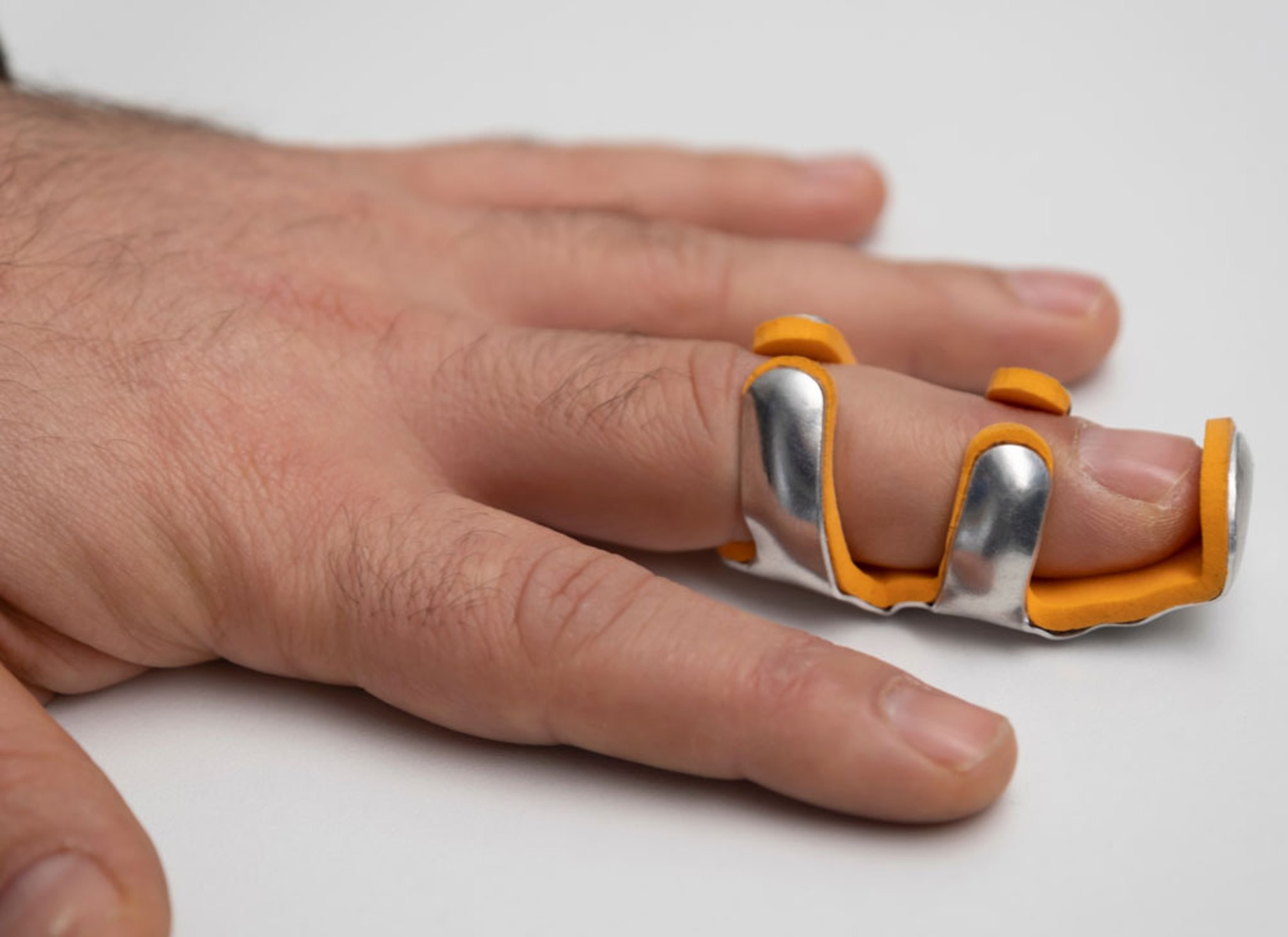
batuhan toker/stock.adobe.com
Additional Considerations
Dislocations and angulated fractures should be reduced before splinting.
Consider administering a digital block with local anesthesia prior to splinting if manipulation is required.
Often, to minimize stiffness, only the affected interphalangeal joint is immobilized, leaving the unaffected joint free range of motion (eg, mallet finger).
Some finger injuries (eg, angulated or unstable proximal phalanx fractures) require immobilization of the metacarpals and wrist with gutter splinting.
Position of Joint
The patient should be positioned so that the operator has appropriate access to the patient's affected finger.
Final joint positioning and choice of joint immobilization technique depend on the type of injury. Below are splinting positions for some specific injuries.
Distal phalanx fracture (also called a tuft fracture): DIP joint in full extension
Dorsal extensor tendon injury (eg, mallet finger), which usually presents with the patient's inability to extend the distal phalanx at the DIP joint: Splint only the DIP joint in hyperextension
Volar flexor tendon injury (eg, jersey finger), which presents with the inability to flex the distal phalanx at the DIP joint): Splint the distal and proximal interphalangeal joints (DIP and PIP, respectively) in slight flexion (eg, 15 to 30°)
MCP dislocation: MCP joint in approximately 50° flexion
Middle phalanx fractures are classified based on location (head, neck, shaft, base) and deformity
Step-by-Step Description of Procedure
Choose (or fabricate) a splint of the appropriate length.
For full finger splints, measure dorsally from the MCP joint to the tip of the finger.
For splints that also include the MCP joint, cut a length that extends from just past the fingertip to the base of the metacarpals.
If cutting the splint leaves any sharp edges, wrap cloth tape over the edges to prevent injury.
Mold the splint to immobilize the finger in the appropriate position.
Place the splint on the dorsal surface of the finger.
Secure the splint to the finger using tape around each phalanx to immobilize the target joint or joints (eg, for PIP immobilization, apply tape around the proximal and middle phalanges).
Aftercare
Arrange or recommend appropriate follow-up.
Tell the patient to keep the splint dry to prevent skin maceration.
Advise patients with extensor tendon injury to keep the finger in extension during splint changes as healing is disrupted with any flexion and can prolong recovery.
Instruct the patient to seek further care if pain cannot be controlled with oral medications at home.
Warnings and Common Errors
For distal phalanx injuries, extend the splint past the end of the finger so the fingertip is protected.
Account for the actual length of the patient's phalanges when forming the bends in the splint.
Immobilize only the joints necessary for the particular injury. Full finger immobilization is not indicated in all finger injuries and can lead to joint stiffness.
Because finger movement is facilitated by a complex system of flexor and extensor tendons, careful and sometimes detailed examination is critical to identifying the appropriate splint type.
Tips and Tricks
After cutting and bending a straight aluminum-foam splint, round off and smooth the cut corners so they do not poke the patient. Wrap the cut edge with cloth tape to prevent injury from the sharp edges.
Frog splints are applied to the volar surface of the finger.
U-shaped aluminum splints are useful for distal phalanx fractures because they provide additional protection to the fingertip.
Buddy-taping (taping 2 fingers together) immobilization is another tool for minor finger sprains.