A lower esophageal ring is a 2- to 4-mm mucosal stricture that causes a ringlike narrowing of the distal esophagus at the squamocolumnar junction that often causes dysphagia.
The etiology of lower esophageal rings is unknown; they may be congenital or caused by gastroesophageal reflux or pill-induced esophagitis (1).
These rings cause intermittent dysphagia for solids. Symptoms can begin at any age but usually do not begin until middle adulthood, with a mean age of presentation of 57 years in one study (2). The swallowing difficulty comes and goes and is especially aggravated by meat and dry bread. Symptoms usually occur only when the esophageal lumen is < 12 mm in diameter and almost never when it is > 20 mm (3).
Typically, evaluation of dysphagia begins with upper endoscopy, which should show a ring large enough to cause symptoms. If the distal esophagus is adequately distended, barium radiographs usually also show the ring.

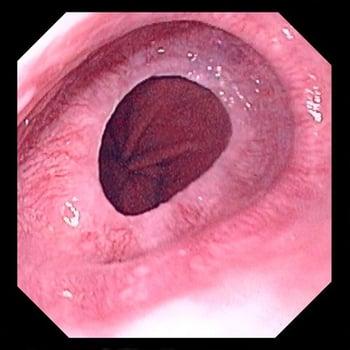
Esophageal rings (also called Schatzki rings) are smooth, concentric, mucosal folds that narrow the esophagus at the esophogastric junction. A hiatus hernia can be seen through the lumen of this ring.

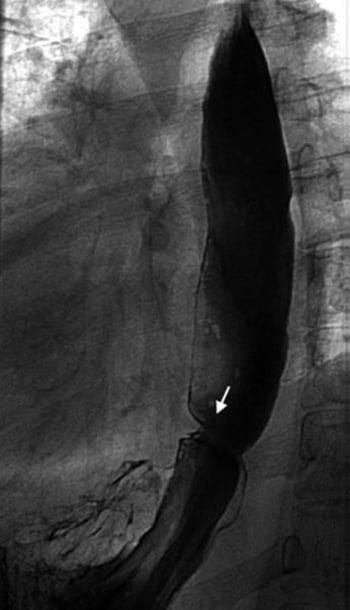
This image shows a Schatzki ring (arrow).
Instructing the patient to chew food thoroughly, with sips of water, is usually the only treatment required in wider rings, but narrow-lumen rings require dilation by endoscopy or bougienage (dilation with a thin rod of rubber or plastic). Surgical resection is rarely required.
References
1. Sgouros SN, Vlachogiannakos J, Karamanolis G, et al. Long-term acid suppressive therapy may prevent the relapse of lower esophageal (Schatzki's) rings: a prospective, randomized, placebo-controlled study. Am J Gastroenterol. 2005;100(9):1929-1934. doi:10.1111/j.1572-0241.2005.41184.x
2. Müller M, Gockel I, Hedwig P, et al. Is the Schatzki ring a unique esophageal entity? World J Gastroenterol. 2011;17(23):2838-2843. doi:10.3748/wjg.v17.i23.2838
3. Pezzullo JC, Lewicki AM. Schatzki ring, statistically reexamined. Radiology. 2003;228(3):609-613. doi:10.1148/radiol.2283021162