Chronic paronychia is recurring or persistent inflammation of the nail fold, typically of the fingernails.
(See also Acute Paronychia.)
Chronic paronychia occurs almost always in people whose hands are chronically wet (for example, dishwashers, bartenders, and housekeepers), particularly if they have hand eczema, diabetes, or an impaired immune system. Some medications used to treat certain cancers or suppress the immune system (for example, after an organ transplant) may cause chronic paronychia. These medications include gefitinib, erlotinib, sirolimus, everolimus, vemurafenib, dabrafenib, and related medications. The yeast Candida is often present, but its role in causing chronic paronychia is unclear because eliminating the yeast completely does not always cure the condition. Chronic paronychia may be the result of an irritant skin inflammation (dermatitis) in addition to the presence of Candida.
The nail fold (the fold of hard skin at the sides of the nail plate where the nail and skin meet) is painful, tender, and red as in acute paronychia, but pus usually does not accumulate. Often there is loss of the cuticle (the skin at the base of the nail) and separation of the nail fold from the nail plate (the hard part of the nail). A space then forms that allows irritants and microorganisms to enter. The nail can become distorted.

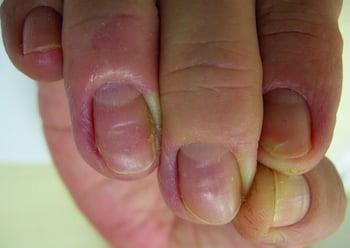
This image shows red, swollen nail folds and the loss of the cuticles as seen in chronic paronychia.
The doctor makes the diagnosis of chronic paronychia by examining the affected finger.
Treatment of Chronic Paronychia
Avoiding excessive exposure to water
Steroids (sometimes also called glucocorticoids or corticosteroids) or tacrolimus
Sometimes steroid injections into the nail fold
Sometimes antifungal medications
Keeping the hands dry and protected can help the cuticle re-form and close the space between the nail fold and nail plate. Gloves or barrier creams are used if water contact is necessary.
Steroid creams applied to the nail may be helpful. Steroids may also be injected into the nail fold. Tacrolimus cream may also be given.
Antifungal medications (such as fluconazole taken by mouth) are given only if people are at risk of Candida overgrowth.
Drug Information for the Topic