Alopecia areata is sudden loss of patches of hair when there is no obvious cause, such as a skin or general internal disorder.
(See also Overview of Hair Growth and Hair Loss [Alopecia].)
Alopecia areata is common. It occurs in both sexes and at all ages but is most common among children and young adults.
The cause of alopecia areata is believed to be an autoimmune reaction in which the body’s immune defenses mistakenly attack the hair follicles. Alopecia areata is not the result of another disorder, but some people may also have a coexisting thyroid disorder or vitiligo (a skin pigment disorder).

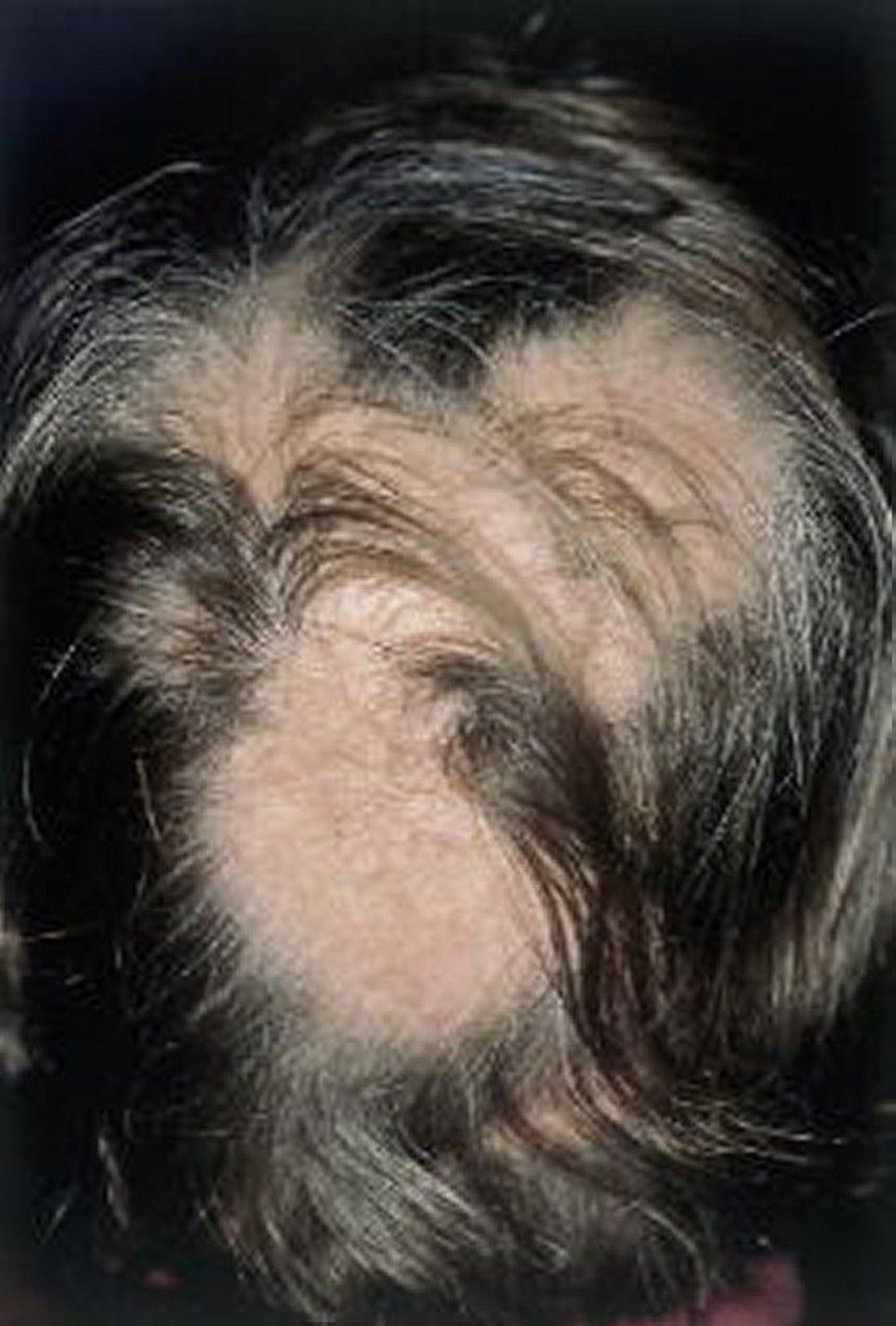
This photo shows patchy areas of hair loss on the scalp in alopecia areata.
© Springer Science+Business Media

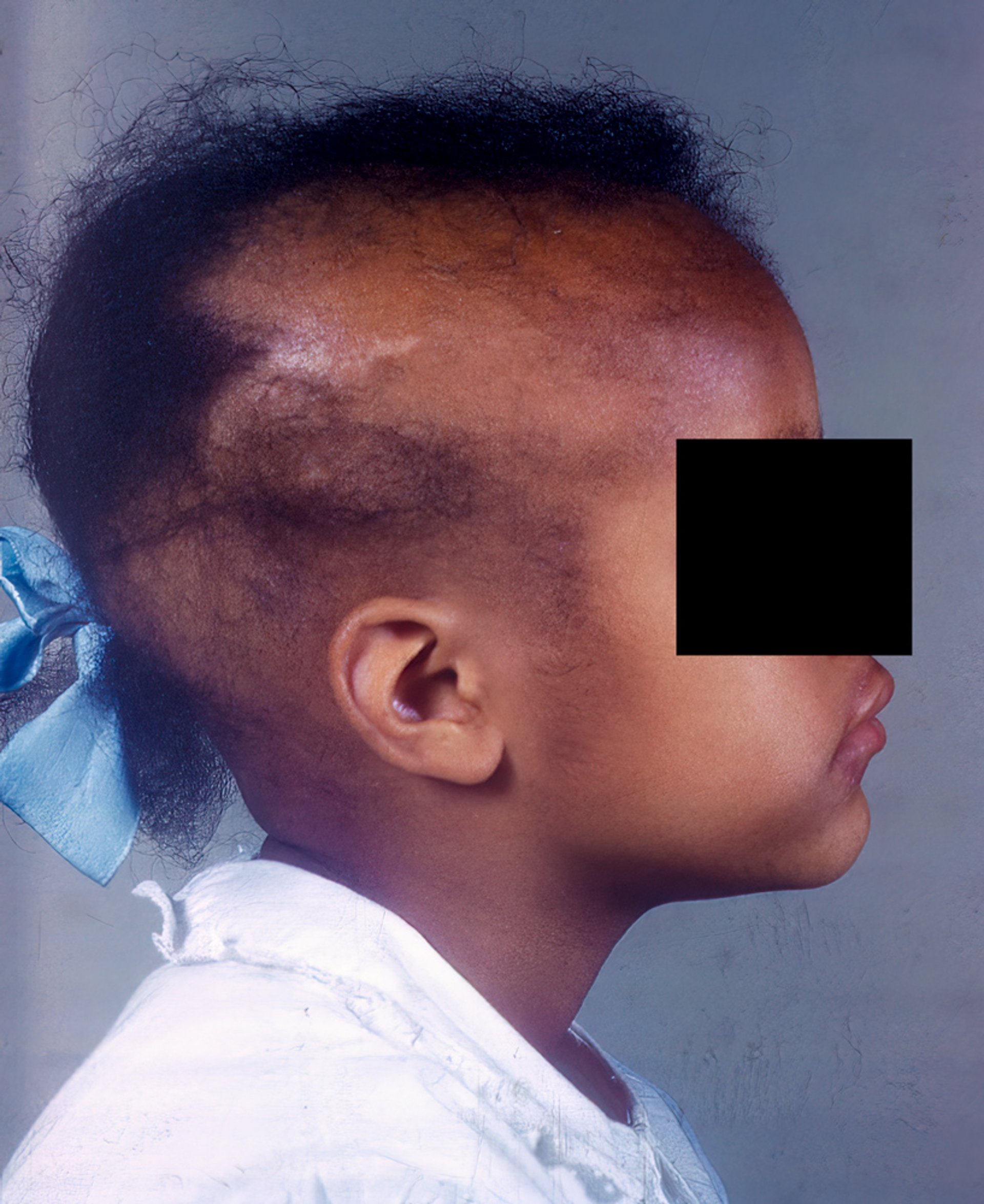
This photo shows oval patches of hair loss consistent with alopecia areata.
Photo courtesy of Karen McKoy, MD.
Symptoms of Alopecia Areata
Round, irregular patches of hair are suddenly lost. Around the edges of the patches are characteristic short, broken hairs, which resemble exclamation points. The site of hair loss is usually the scalp or beard. Sometimes all the scalp hair is lost (alopecia totalis), hair is lost from around the side and back edges of the scalp (ophiasis), or hair is lost on the top of the head but not at the edges of the scalp (sisaipho). Rarely, all body hair is lost (a condition called alopecia universalis).
The nails may become pitted or rough, or the half moon at the base of the nails (the lunula) may be red.
Diagnosis of Alopecia Areata
A doctor's evaluation
Doctors examine the scalp, body surface, and nails.
To rule out other disorders, doctors may do testing.
Other disorders that can cause symptoms similar to alopecia areata include:
If the cause is uncertain based upon physical examination, other laboratory studies or biopsy can be done. Patients with clinical findings suggesting associated autoimmune diseases (particularly thyroid disease) are tested for those diseases.
Treatment of Alopecia Areata
Steroids (also sometimes known as glucocorticoids or corticosteroids)
Medications or chemicals applied directly to the skin
Sometimes baricitinib, ritlecitinib,deuruxolitinib, or methotrexate
Alopecia areata can be treated with steroids. For small bald patches, steroids are typically injected under the skin of the bald patch, and minoxidil may be applied directly to the bald patch as well. For larger patches, steroids can be applied to the scalp or, more rarely, taken by mouth.
Other treatments for alopecia areata involve applying chemicals, such as anthralin, diphenylcyclopropenone, or squaric acid dibutylester to the scalp to induce a mild irritant reaction or mild allergic reaction, which sometimes promotes hair growth. These treatments are usually given to people who have widespread hair loss and who have not been helped by other treatments.
For more severe cases, people may be given methotrexate taken by mouth. This medication may be combined with steroids taken by mouth. Baricitinib, ritlecitinib, and deuruxolitinib, medications called Janus kinase (JAK) inhibitors (which are used in treating other autoimmune and blood disorders), are useful in treating alopecia areata.
Sometimes doctors use psoralen and ultraviolet A light therapy (PUVA) in people for whom conventional therapy does not work. This therapy is not widely used because of its limited success and the high relapse rates of people who use it.
The doctor and person may choose to allow alopecia areata to resolve on its own, which sometimes happens without treatment in milder cases. In some people, the hair may grow back in several months. In people with widespread hair loss, regrowth is less likely.
More Information
The following English-language resource may be useful. Please note that The Manual is not responsible for the content of this resource.
Drug Information for the Topic