


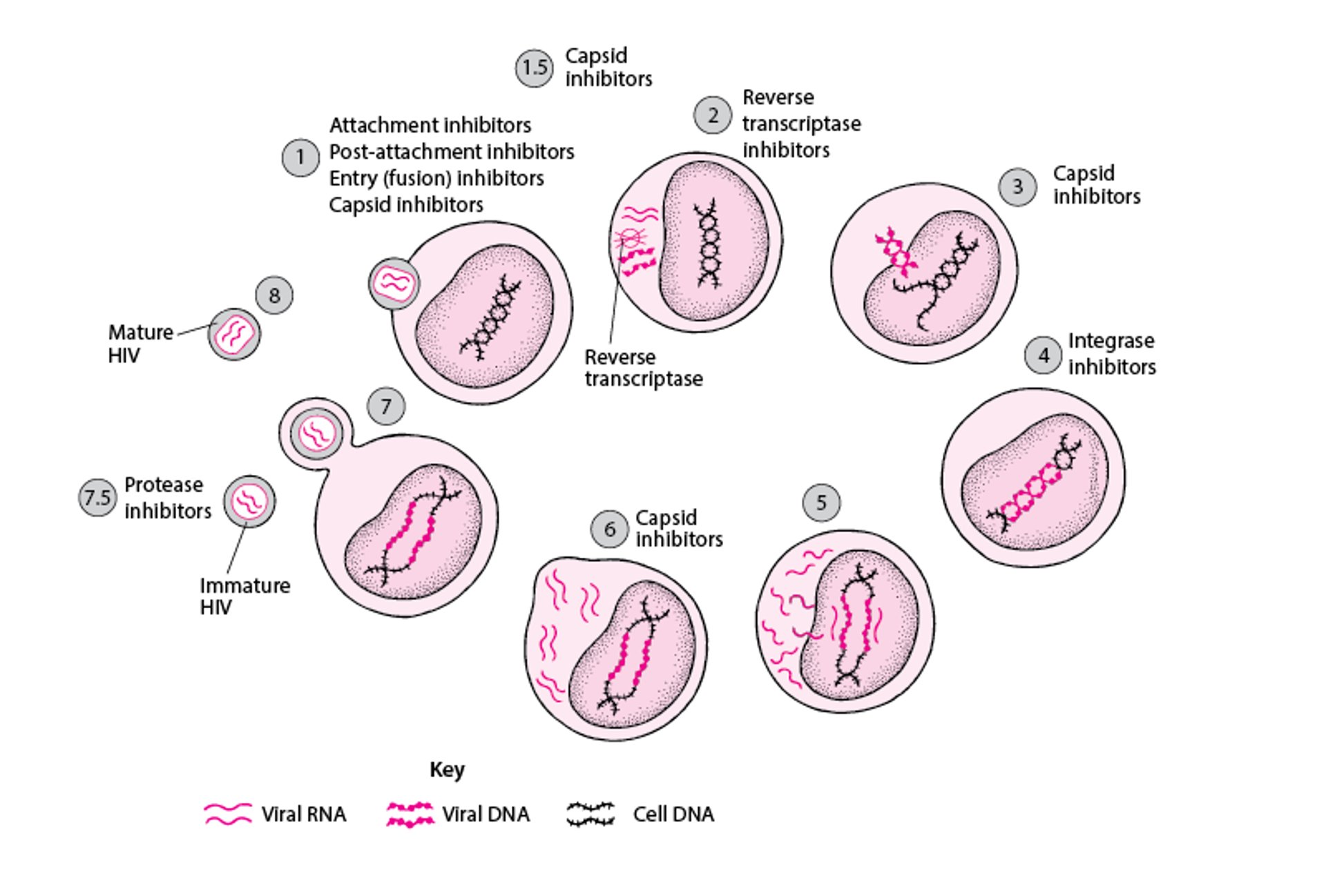
Sites of Medication Action on Life Cycle of HIV
Medications used to treat HIV infection were developed based on the life cycle of HIV. These medications prevent HIV from entering T cells or inhibit 1 of the 3 enzymes (reverse transcriptase, integrase, and protease) that the virus uses to replicate (reproduce) or to attach to and enter cells.
1. HIV first attaches to and enters its target cell. The classes of antiretroviral medications that act against HIV at this stage are entry (fusion) inhibitors, attachment inhibitors, post-attachment inhibitors, and capsid inhibitors.
1.5. After entering the cell, the outer shell (capsid) of HIV undergoes uncoating and is transported within the cell. At this stage, the class of medications that acts against HIV is capsid inhibitors. These medications interfere with capsid function and prevent viral replication.
2. HIV releases RNA, the genetic code of the virus, into the cell. For the virus to replicate, its RNA must be converted into DNA. At this stage, the class of medications that acts against HIV is reverse transcriptase inhibitors. These medications prevent the HIV enzyme called reverse transcriptase from converting HIV RNA into DNA.
3. The HIV DNA enters the cell’s nucleus. Capsid inhibitors can prevent this from happening.
4. With the help of an enzyme produced by HIV called integrase, the HIV DNA becomes integrated into the cell’s DNA. At this stage, the class of medications that acts against HIV is integrase inhibitors. These medications prevent HIV DNA from being integrated into human DNA.
5. The DNA of the infected cell now produces HIV RNA and proteins needed to assemble a new virus.
6. A new virus is assembled from RNA and short pieces of protein. Capsid inhibitors can interfere with proper assembly of the virus.
7. The immature virus pushes (buds) through the cell membrane, wrapping itself in a fragment of the cell membrane before pinching off from the infected cell. At this stage, the immature virus can not yet infect other cells.
7.5 and 8. To be able to infect other cells, the budded virus must mature. It becomes mature when another enzyme produced by HIV called protease breaks up structural proteins in the immature virus, causing them to rearrange. At this stage, the class of medications that acts against HIV is protease inhibitors. These medications prevent the maturation of HIV.