Leprosy is a rare, chronic infection caused by the bacteria Mycobacterium leprae or Mycobacterium lepromatosis. It results in damage primarily to the peripheral nerves (the nerves outside the brain and spinal cord), skin, testes, eyes, and mucous membranes of the nose and throat.
Leprosy ranges from mild (with one or a few skin areas affected) to severe (with many skin areas affected and damage to many organs).
Rashes and bumps appear, the affected areas become numb, and muscles may become weak.
The diagnosis is suggested by symptoms and is confirmed by biopsy and testing of the affected tissue.
Antibiotics can stop leprosy from progressing and cure the infection, but they cannot reverse any nerve damage or deformity.
Although leprosy is not highly contagious, is rarely fatal, and can be effectively treated with antibiotics, it still has considerable social stigma attached to it. People with untreated leprosy become visibly disfigured and often have significant disability, causing them to be feared and shunned by others. As a result, people with leprosy and their family members often have psychologic and social problems.
In 2023, 182,815 new cases of leprosy were reported worldwide, and most of them occurred in India, Brazil, and Indonesia.
In 2024, 205 new cases were reported in the United States. Many of these cases occurred in California, Florida, Hawaii, New York, Texas, Georgia, Illinois, and Louisiana. Leprosy that is acquired in the United States often occurs in people in southern states who have direct contact with nine-banded armadillos, which carry Mycobacterium leprae bacteria. Most leprosy that is acquired outside the United States occurs in people who worked in or emigrated from countries where leprosy is common.
Leprosy can develop at any age. Older age is a risk factor for leprosy, but the infection appears to develop most often in people who are 5 to 15 years old or over 30 years old.
Most people who are infected with Mycobacterium leprae do not develop leprosy because their immune system fights off the infection. People who do develop leprosy may have genes that make them susceptible to the infection once they are exposed.
Transmission of Leprosy
Leprosy may be passed from person to person through droplets expelled from the nose and mouth of an infected person and breathed in or touched by an uninfected person.
Casual contact and short-term contact do not seem to spread the disease. Leprosy cannot be contracted by simply touching someone with the infection, as is commonly believed.
Did You Know...
|
Armadillos are one confirmed source of transmission other than people, but there are reports of Mycobacterium leprae in red squirrels in the British Isles. Natural leprosy infections have also been reported in primates in the wild (for example, wild chimpanzees, sooty mangabeys, and cynomolgus macaques), but it is not clear whether these animals can transmit the bacteria to humans.
Even after contact with the bacteria, most people do not develop leprosy. Health care professionals often work for many years with people who have leprosy and do not develop the infection.
Classification of leprosy
Leprosy can be classified by the type and number of skin areas affected:
Paucibacillary: People with paucibacillary leprosy have 5 or fewer affected skin areas. No bacteria can be detected in samples taken from these areas.
Multibacillary: People with multibacillary leprosy have 6 or more affected skin areas, have bacteria detected in samples taken from an affected area, or both.
Leprosy can also be classified based on the symptoms people have and other findings:
Tuberculoid: People with tuberculoid leprosy typically have few affected skin areas (paucibacillary), and the disease is milder, causes fewer symptoms (with skin sores), and less contagious compared to lepromatous leprosy.
Lepromatous: People with lepromatous leprosy usually have more affected skin areas (multibacillary) and severe widespread infection of the nerves and other organs. The disease is more contagious.
Borderline: People with borderline leprosy have features of tuberculoid leprosy and lepromatous leprosy. Over time, it can become less symptomatic like tuberculoid leprosy or more symptomatic like lepromatous leprosy.
In both classifications, the type of leprosy determines the following:
How well people fare in the long term
What complications are likely
How long antibiotic treatment is needed
Symptoms of Leprosy
Because the bacteria that cause leprosy multiply very slowly, symptoms usually do not begin for more than 1 year after people have been infected. On average, symptoms may appear a few months to 20 years after infection. Once symptoms begin, they progress slowly.
Leprosy affects mainly the skin and peripheral nerves (the nerves outside the brain and spinal cord). Characteristic rashes and bumps develop. They are not itchy. Infection of the nerves makes the skin numb or the muscles weak in areas controlled by the infected nerves.
Specific symptoms vary depending on the type of leprosy:
Tuberculoid leprosy: A rash appears, consisting of one or a few flat, lighter areas with sharp, raised borders. Areas affected by this rash are numb because the bacteria damage the underlying nerves.
Lepromatous leprosy: Many small or larger raised bumps of variable size and shape appear on the skin. There are more areas of numbness than in tuberculoid leprosy, and certain muscle groups may be weak. Much of the skin and many areas of the body, including the kidneys, nose, and testes, may be affected. People may lose their eyelashes and eyebrows or their breasts may enlarge.
Borderline leprosy: People have symptoms of both tuberculoid and lepromatous leprosy. Without treatment, borderline leprosy may become less severe and more like tuberculoid leprosy, or it may worsen and become more like lepromatous leprosy.
Complications of leprosy
The most severe complications result from infection of the peripheral nerves, which causes deterioration of the sense of touch and a corresponding inability to feel pain and temperature. People with peripheral nerve damage may unknowingly burn, cut, or otherwise harm themselves. Repeated damage may eventually lead to loss of fingers and toes. Also, damage to peripheral nerves may cause muscle weakness that can result in deformities. For example, the fingers may be weakened, causing them to curve inward (like a claw). Muscles may become too weak to flex the foot (a condition called foot drop). Infected nerves may enlarge enough that doctors are able to feel them during a physical examination.

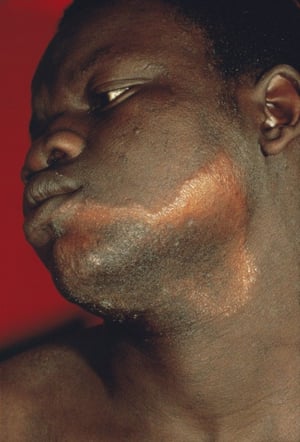
Tuberculoid leprosy causes a rash consisting of lighter areas with sharp, raised borders. Areas affected by this rash are numb because the bacteria damage the nerves underneath.
Tuberculoid leprosy causes a rash consisting of lighter areas with sharp, raised borders. Areas affected by this rash a
CNRI/SCIENCE PHOTO LIBRARY

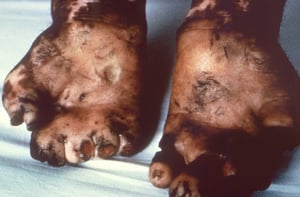
In this person, leprosy has caused part of the fingers of both hands to be lost.
In this person, leprosy has caused part of the fingers of both hands to be lost.
CDC/ Arthur E. Kaye

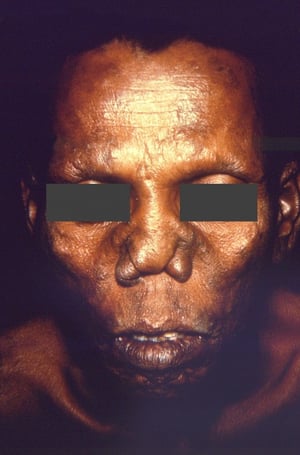
In this person, leprosy has caused the cartilage in the nose to disintegrate.
In this person, leprosy has caused the cartilage in the nose to disintegrate.
CDC/ Dr. Andre J. Lebrun
Tuberculoid leprosy causes a rash consisting of lighter areas with sharp, raised borders. Areas affected by this rash are numb because the bacteria damage the nerves underneath.
Tuberculoid leprosy causes a rash consisting of lighter areas with sharp, raised borders. Areas affected by this rash a
CNRI/SCIENCE PHOTO LIBRARY
In this person, leprosy has caused part of the fingers of both hands to be lost.
In this person, leprosy has caused part of the fingers of both hands to be lost.
CDC/ Arthur E. Kaye
In this person, leprosy has caused the cartilage in the nose to disintegrate.
In this person, leprosy has caused the cartilage in the nose to disintegrate.
CDC/ Dr. Andre J. Lebrun
Skin infection can lead to areas of swelling and lumps, which can be particularly disfiguring on the face.
Other areas of the body may be affected:
Feet: Sores may also develop on the soles of the feet, making walking painful.
Nose: Damage to the nasal passages can result in a chronically stuffy nose and nosebleeds and, if untreated, complete erosion of the cartilage in the nose.
Eyes: Damage to the eyes may lead to glaucoma or blindness.
Sexual function: Men with lepromatous leprosy may have erectile dysfunction (impotence) and infertility. The infection can reduce the amount of testosterone and sperm produced by the testes.
Kidneys: Amyloidosis (a build up of proteins in organs such as the heart and kidneys) and kidney failure occasionally occur in lepromatous leprosy.
Leprosy reactions
During the course of untreated or even treated leprosy, the immune system may react by producing inflammation in various parts of the body.
These reactions can cause fever and inflammation of the skin, peripheral nerves, and, less commonly, the lymph nodes, joints, testes, kidneys, liver, and eyes. The reactions can also contribute to nerve damage. The skin around bumps may swell and become red and painful, and the bumps may become open sores (ulcers).
Diagnosis of Leprosy
Examination of a sample of infected skin tissue
Doctors may suspect leprosy based on a person's symptoms, such as distinctive rashes that do not disappear, enlarged nerves, loss of the sense of touch, and deformities that result from muscle weakness. But in the United States, doctors may not think of leprosy right away because it is rare and they are unfamiliar with its symptoms.
Examination of a sample of infected skin tissue under a microscope (biopsy) is done to confirm the diagnosis.
Polymerase chain reaction (PCR) testing may be done on the sample. It produces many copies of a gene, making identification of the bacteria’s DNA easier.
Blood tests to measure antibodies to the Mycobacterium leprae bacteria have limited usefulness because antibodies are not always present in every infected person. (Antibodies are produced by the immune system to help defend the body against a particular attacker, including leprosy bacteria.)
Treatment of Leprosy
Antibiotics
Antibiotics can stop the progression of leprosy but do not reverse any nerve damage or deformity. Thus, early detection and treatment are very important.
Because leprosy bacteria become resistant to an antibiotic if it is used alone, doctors prescribe more than one antibiotic.
Because the bacteria are difficult to eradicate, antibiotics must be continued for a long time. Depending on the severity of the infection, antibiotics are taken for 6 to 12 months and sometimes for up to 2 years.
The antibiotics chosen depend on the type of leprosy. All of them are taken by mouth (orally):
Multibacillary: In the United States, adults are given rifampin, minocycline, and moxifloxacin once a month for 24 months. In other parts of the world, adults are given rifampin and clofazimine once a month under a health care professional’s supervision and dapsone plus clofazimine once a day on their own. This regimen is continued for 12 months.
Paucibacillary: In the United States, adults are given rifampin, moxifloxacin, and minocycline once a month for 24 months. In other parts of the world, adults are given rifampin and clofazimine once a month with supervision and dapsone plus and clofazimine once a day without supervision for 6 months.
Dapsone is relatively inexpensive and generally safe to use. It occasionally causes allergic rashes and anemia.
Rifampin is even more effective than dapsone. Its most serious side effects are damage to the liver, flu-like symptoms, and, rarely, kidney failure.
Clofazimine is extremely safe. The main side effect is temporary skin pigmentation, which may take months to disappear.
Minocycline is an effective antibiotic for leprosy and is used primarily in the United States. The main side effect is skin discoloration, including gray-black pigmentation of affected areas, and discoloration of the tongue, lips, and gums.
Moxifloxacin is another effective antibiotic for leprosy and is mainly used in the United States. The main side effect is tendon problems that include tendinitis and tendon rupture, most commonly affecting the Achilles tendon (tendon above the heel).
Leprosy reactions are treated with oral steroids (sometimes called corticosteroids or glucocorticoids). Mild skin inflammation does not require any treatment.
Prevention of Leprosy
Because leprosy is not very contagious, the risk of spread is low. Only the untreated lepromatous form is contagious, although even then the infection is not easily spread. Once treatment has begun, leprosy cannot be spread.
The best way to prevent leprosy is to:
Avoid contact with bodily fluids (including respiratory droplets) from and the rash on infected people.
Avoid contact with armadillos.
People who are household or otherwise close contacts of people who have leprosy and who are over 2 years of age can be given a single dose of the antibiotic rifampin as preventive treatment. This medication is given only after doctors have ruled out leprosy and tuberculosis (TB) and have determined that people have no other issues that would prevent them from taking the medication.
The BCG (bacille Calmette-Guérin) vaccine, used to prevent TB, provides some protection against leprosy, but it is not often used to prevent leprosy.
Drug Information for the Topic