Clubfoot (talipes equinovarus) is a birth defect in which the foot and ankle are twisted out of shape or position. Other foot defects include metatarsus adductus, metatarsus varus, talipes calcaneovalgus, and flat feet (pes planus).
Birth defects, also called congenital anomalies, are physical abnormalities that occur before a baby is born. "Congenital" means "present at birth." (See also Introduction to Birth Defects of the Bones, Joints, and Muscles.)
Clubfoot (talipes equinovarus)
The usual clubfoot is a down and inward turning of the hind foot and ankle, with twisting inward of the forefoot. Sometimes the foot only appears abnormal because it was held in an unusual position in the womb (positional clubfoot).
In contrast, a structurally abnormal foot results from an error in the baby's development while in the womb (true clubfoot). With true clubfoot, the bones of the leg or foot or the muscles of the calf are often underdeveloped. Sometimes true clubfoot leads to a tightened Achilles tendon. This tendon runs from the calf muscles and attaches to the heel bone. If it is too tight, it pulls the heel up in the back into an inflexible position (see Talipes Equinus in figure ).
Common Types of Clubfoot

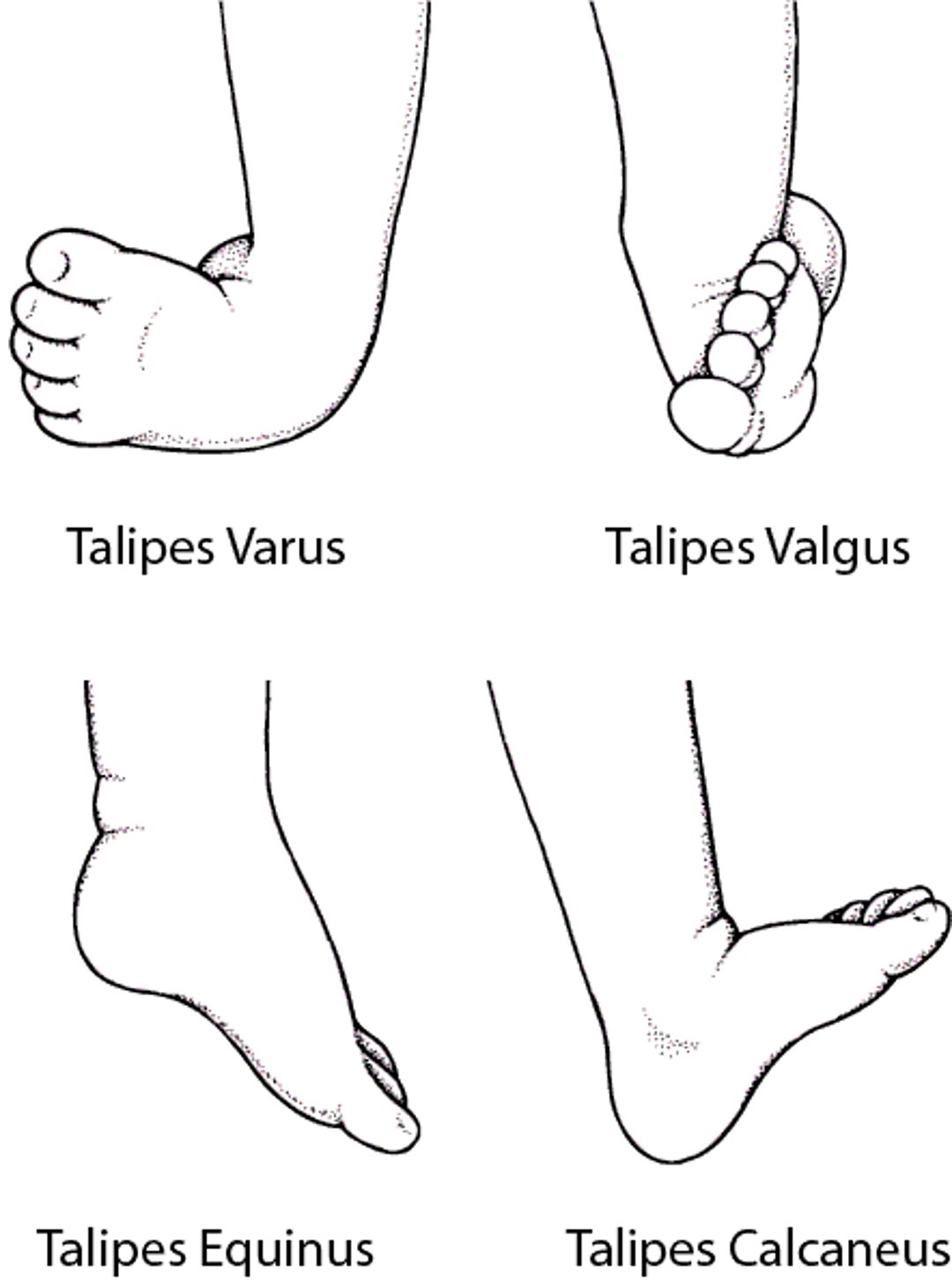
Larsen syndrome is a genetic disorder in which children are born with clubfeet and dislocations of the hips, knees, and elbows.
Treatment of clubfoot begins as early as possible. Doctors correct a clubfoot by moving the foot into the proper position and then placing the foot in a cast to hold it in place. The cast goes above the child's knee. Each week, doctors remove the cast, stretch the foot and ankle, and put on a new cast to gradually reposition the foot. Typically, about 5 to 8 casts are needed. During this part of treatment, doctors can perform a brief procedure called tenotomy to release the Achilles tendon if it is too tight. Once the foot is in the correct position, doctors remove the last cast and put on a brace. The brace is taken on and off by parents or caregivers at home. The child wears the brace until the child is around 4 years old.


This photo shows special rigid braces used to support and properly align a child's feet and lower legs during treatment of clubfoot. Unlike casts, braces are removable.
Towfiqu Barbhuiya/stock.adobe.com
If the casts, tenotomy, and brace do not correct the clubfoot or the child's abnormality is severe or returns, surgery may be needed. Clubfoot can return after surgery.


This photo shows a person who has uncorrected clubfoot of the left foot.
Metatarsus adductus
In metatarsus adductus, the foot is turned inward. Mobility of the joints of the foot and ankle may be limited.
Treatment of metatarsus adductus depends on the severity of the deformation and immobility of the foot. Most cases resolve spontaneously during the child's first year of life. If metatarsus adductus does not resolve, doctors place the foot in a series of casts to move and hold it in the proper position until the child is 3 or 4 years old, or doctors correct it with surgery.


In metatarsus adductus, the foot turns inward.
Metatarsus varus
In metatarsus varus, the bottom surface of the foot is turned inward, so that the arch is raised. This defect usually results from abnormal positioning in the womb.
Metatarsus varus does not usually resolve on its own after birth, and doctors may place the foot in a cast to move and hold it in the proper position until the child is walking.


In metatarsus varus, the bottom surface of the foot is turned inward, so that the arch is raised.
Talipes calcaneovalgus
In talipes calcaneovalgus, the foot is flat or rounded and bent backward with the heel turned outward.
In many children, talipes calcaneovalgus goes away on its own. If it does not, doctors place the foot in a cast to move and hold it in the proper position or have children wear a brace until they are walking.


In talipes calcaneovalgus, the heel turns outward.
Flat feet (pes planus)
In flat feet, the normal arch in the middle of the foot appears flattened. At birth, most children have flat feet. The arch develops gradually over the first 10 years of the child's life and is fully formed by adolescence.
There are 2 main types of flat feet:
Flexible flat feet
Rigid flat feet (also called stiff flat feet)
In flexible flat feet, the feet remain flat because the arch of the foot is unusually flexible. A child who has flexible flat feet usually does not require treatment. However, if an older child has pain or cramps in the feet, special shoes may need to be worn or orthotic inserts may need to be used in shoes.
In rigid flat feet, the bones of the feet are fixed in a flattened position. Tarsal coalition is one cause of rigid flat feet and may result from a birth defect or from conditions such as injuries or prolonged swelling. Treatment of tarsal coalition often includes wearing a cast. Sometimes doctors surgically separate the bones of the stiffened foot joint to restore mobility to the foot.


In flat feet, the normal arch in the middle of the foot appears flattened.