Incompetence of the lower esophageal sphincter allows reflux of gastric contents into the esophagus, causing burning pain. Prolonged reflux may lead to esophagitis, stricture, and rarely metaplasia or cancer. Diagnosis is clinical, sometimes with endoscopy, with or without acid testing. Treatment involves lifestyle modification, acid suppression using proton pump inhibitors, and sometimes surgical repair.
Gastroesophageal reflux disease (GERD) is common, affecting approximately 13% of the worldwide population (1, 2). The prevalence varies by region and increases with age (1).
Gastroesophageal reflux is also common in infants, typically beginning at birth, but is not always pathologic or considered GERD. For more information, see GERD in infants.
General references
1. Fass R. Gastroesophageal Reflux Disease. N Engl J Med. 2022;387(13):1207-1216. doi:10.1056/NEJMcp2114026
2. Maret-Ouda J, Markar SR, Lagergren J. Gastroesophageal Reflux Disease: A Review. JAMA. 2020;324(24):2536-2547. doi:10.1001/jama.2020.21360
Etiology of GERD
The presence of reflux implies lower esophageal sphincter (LES) incompetence, which may result from a generalized loss of intrinsic sphincter tone or from recurrent inappropriate transient relaxations (ie, unrelated to swallowing). Transient LES relaxations are triggered by gastric distention or subthreshold pharyngeal stimulation.
Factors that contribute to the competence of the gastroesophageal junction include the angle of the cardioesophageal junction, the action of the diaphragm, gravity (ie, an upright position), and the patient's age. Factors that may contribute to reflux include obesity, tobacco smoking, fatty foods, caffeinated or carbonated beverages, alcohol, and medications (1). Medications that lower LES pressure include anticholinergics, antihistamines, tricyclic antidepressants, calcium channel blockers, progesterone, and nitrates. Genetic predisposition also appears to play a role.). Medications that lower LES pressure include anticholinergics, antihistamines, tricyclic antidepressants, calcium channel blockers, progesterone, and nitrates. Genetic predisposition also appears to play a role.
Complications of GERD
GERD may lead to esophagitis, esophageal ulcer, esophageal stricture, Barrett esophagus (replacement of normal squamous epithelium of the distal esophagus with metaplastic columnar epithelium during the healing phase of acute esophagitis), and esophageal adenocarcinoma.
Bleeding from the inflamed portion of the esophagus can cause iron deficiency anemia over time.
Factors that contribute to the development of esophagitis include the caustic nature of the refluxate, the inability to clear the refluxate from the esophagus, the volume of gastric contents, and local mucosal protective functions. Some patients, particularly infants, may aspirate the reflux material; however, the cause of pulmonary aspiration is rarely GERD.

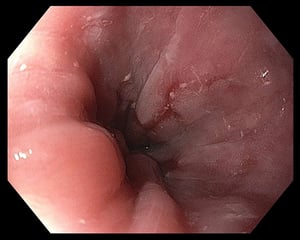
This image shows grade B esophagitis.
This image shows grade B esophagitis.
Image provided by Kristle Lynch, MD.

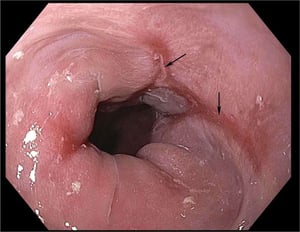
Gastroesophageal reflux may cause esophagitis (here grade C) to manifest as distal esophageal erosions and ulcerations (arrows). Scarring may eventually lead to stricture.
Gastroesophageal reflux may cause esophagitis (here grade C) to manifest as distal esophageal erosions and ulcerations
Image provided by Kristle Lynch, MD.

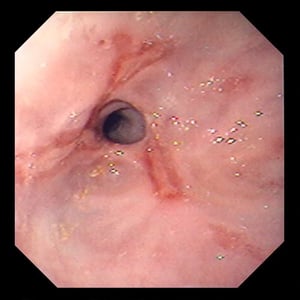
This image shows esophageal stricture caused by longstanding reflux disease and also shows superficial ulcerations.
This image shows esophageal stricture caused by longstanding reflux disease and also shows superficial ulcerations.
Image provided by David M. Martin, MD.

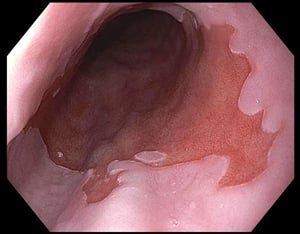
In this image of Barrett esophagus, red-appearing bands of metaplastic epithelium can be seen extending proximally.
In this image of Barrett esophagus, red-appearing bands of metaplastic epithelium can be seen extending proximally.
Image provided by Kristle Lynch, MD.
This image shows grade B esophagitis.
This image shows grade B esophagitis.
Image provided by Kristle Lynch, MD.
Gastroesophageal reflux may cause esophagitis (here grade C) to manifest as distal esophageal erosions and ulcerations (arrows). Scarring may eventually lead to stricture.
Gastroesophageal reflux may cause esophagitis (here grade C) to manifest as distal esophageal erosions and ulcerations
Image provided by Kristle Lynch, MD.
This image shows esophageal stricture caused by longstanding reflux disease and also shows superficial ulcerations.
This image shows esophageal stricture caused by longstanding reflux disease and also shows superficial ulcerations.
Image provided by David M. Martin, MD.
In this image of Barrett esophagus, red-appearing bands of metaplastic epithelium can be seen extending proximally.
In this image of Barrett esophagus, red-appearing bands of metaplastic epithelium can be seen extending proximally.
Image provided by Kristle Lynch, MD.
Etiology reference
1. Maret-Ouda J, Markar SR, Lagergren J. Gastroesophageal Reflux Disease: A Review. JAMA. 2020;324(24):2536-2547. doi:10.1001/jama.2020.21360
Symptoms and Signs of GERD
The most prominent symptom of GERD in adolescents and adults is heartburn, with or without regurgitation of gastric contents into the mouth. Patients with chronic aspiration may have cough, hoarseness, or wheezing.
Esophagitis may cause odynophagia and even esophageal hemorrhage, which is usually occult but can be massive. Peptic strictures cause a gradually progressive dysphagia for solid foods. Peptic esophageal ulcers cause the same type of pain as gastric or duodenal ulcers, but the pain is usually localized to the xiphoid or high substernal region. Peptic esophageal ulcers heal slowly, tend to recur, and usually leave a stricture on healing.
Diagnosis of GERD
History and physical examination
Endoscopy for patients not responding to empiric treatment
Sometimes advanced pH testing or esophageal manometry
A detailed history points to the diagnosis. Patients with typical symptoms of GERD (heartburn and regurgitation) may be given a trial of acid-suppressing therapy with a proton pump inhibitor (1). Patients who respond do not need further evaluation.
Patients who do not improve, have long-standing symptoms or symptoms of complications, or whose symptoms overlap with other diagnoses, should undergo further testing. Depending on symptoms, the differential diagnosis includes peptic ulcer disease, gastrointestinal mobility disorders, eosinophilic or other esophagitis, gastrointestinal cancer, and ischemic heart disease (2).
Endoscopy, with cytologic washings and/or biopsy of abnormal areas, is the test of choice. Endoscopic biopsy is the only test that consistently detects the columnar mucosal changes of Barrett esophagus. Patients with unremarkable endoscopy findings who have typical symptoms despite treatment with proton pump inhibitors should undergo advanced pH testing. Although barium swallow readily shows esophageal ulcers and peptic strictures, it is less useful for mild to moderate reflux; in addition, most patients with abnormalities require subsequent endoscopy. Endoscopic findings can be used to grade the severity of reflux esophagitis (3):
Grade A: One or more mucosal breaks ≤ 5 mm that do not cross the tops of 2 mucosal folds
Grade B: One or more mucosal breaks > 5 mm that do not cross the tops of 2 mucosal folds
Grade C: One or more mucosal breaks that cross ≥ 2 mucosal folds and involve < 75% of the esophageal circumference
Grade D: One or more mucosal breaks involving ≥ 75% of esophageal circumference
Per the Lyon Consensus, grades B, C, and D esophagitis are considered objective evidence of GERD (1, 4); a normal endoscopy or only grade A esophagitis requires advanced pH testing while off therapy to establish the diagnosis of GERD.
Esophageal manometry is used to evaluate esophageal peristalsis before surgical treatment.
Diagnosis references
1. Katz PO, Dunbar KB, Schnoll-Sussman FH, Greer KB, Yadlapati R, Spechler SJ. ACG Clinical Guideline for the Diagnosis and Management of Gastroesophageal Reflux Disease. Am J Gastroenterol. 2022;117(1):27-56. doi:10.14309/ajg.0000000000001538
2. Maret-Ouda J, Markar SR, Lagergren J. Gastroesophageal Reflux Disease: A Review. JAMA. 2020;324(24):2536-2547. doi:10.1001/jama.2020.21360
3. Sami SS, Ragunath K. The Los Angeles classification of gastroesophageal reflux disease. Video Journal and Encyclopedia of GI Endoscopy. 2013;1(1):103–104. doi: 10.1016/S2212- 0971(13)70046-3103
4. Gyawali CP, Yadlapati R, Fass R, et al. Updates to the modern diagnosis of GERD: Lyon consensus 2.0. Gut. 2024;73(2):361-371. Published 2024 Jan 5. doi:10.1136/gutjnl-2023-330616
Treatment of GERD
Weight loss for patients with overweight/obesity
Avoidance of eating before bedtime
Smoking cessation, if appropriate
Head of bed elevated
Proton pump inhibitors or other medications
Sometimes antireflux surgery
Nonpharmacologic management of uncomplicated GERD consists of limiting food intake within 4 hours of bedtime and elevating the head of the bed approximately 15 cm (6 inches) by placing approximately 15- to 20-cm (6- to 8-inch) blocks under the legs at the head of the bed, by using a wedge pillow, or by placing a wedge under the mattress (1). Weight loss and smoking cessation should be offered when appropriate. Also, patients should consider avoiding the following:
Fatty or large meals
Strong stimulants of acid secretion or reflux (eg, caffeine, alcohol, carbonated beverages)
Specific foods that trigger symptoms (eg, chocolate, citrus)
Certain medications (eg, anticholinergics)
Medical therapy is often with a proton pump inhibitor; some are more potent than others, but all have been shown to be effective, and they are preferred over H2 blockers (1). For example, adults can be given oral omeprazole 20 mg, lansoprazole 30 mg, pantoprazole 40 mg, or esomeprazole 40 mg 30 minutes before a meal (eg, before breakfast, or for twice daily dosing, before breakfast and dinner). In some cases (eg, only partial response to once-a-day dosing), proton pump inhibitors may be given twice daily before meals. These medications may be continued long-term, but the dose should be adjusted to the minimum required to prevent symptoms, including intermittent or as-needed dosing. ). For example, adults can be given oral omeprazole 20 mg, lansoprazole 30 mg, pantoprazole 40 mg, or esomeprazole 40 mg 30 minutes before a meal (eg, before breakfast, or for twice daily dosing, before breakfast and dinner). In some cases (eg, only partial response to once-a-day dosing), proton pump inhibitors may be given twice daily before meals. These medications may be continued long-term, but the dose should be adjusted to the minimum required to prevent symptoms, including intermittent or as-needed dosing.
Potassium-competitive acid blockers (eg, vonoprazan) have been shown in trials to be superior to PPIs in erosive reflux disease, and non-inferior in milder disease (Potassium-competitive acid blockers (eg, vonoprazan) have been shown in trials to be superior to PPIs in erosive reflux disease, and non-inferior in milder disease (2, 3).
H2 blockers are also an effective treatment option for mildly symptomatic GERD, particularly for persistent nocturnal symptoms (1). Promotility agents (eg, metoclopramide 10 mg orally 30 minutes before meals and at bedtime) are less effective but may be added to a proton pump inhibitor regimen. ). Promotility agents (eg, metoclopramide 10 mg orally 30 minutes before meals and at bedtime) are less effective but may be added to a proton pump inhibitor regimen.
Antireflux surgery (usually fundoplication via laparoscopy) is performed in patients with grades C and D esophagitis, large hiatus hernias, hemorrhage, stricture, ulcers, or large amounts of symptomatic nonacid reflux or in those who cannot tolerate medical therapy. Esophageal strictures are most often managed by repeated endoscopic dilation.
Barrett esophagus may or may not regress with medical or surgical therapy. Because Barrett esophagus is a precursor to adenocarcinoma, endoscopic surveillance for malignant transformation is recommended every 3 to 5 years in nondysplastic disease (4). Endoscopic ablative therapy should be considered for patients with confirmed low-grade dysplasia and without life-limiting comorbidity; however, endoscopic surveillance every 12 months is an acceptable alternative. Patients with Barrett esophagus and confirmed high-grade dysplasia should be managed with endoscopic ablative therapy unless they have life-limiting comorbidity. Endoscopic ablative techniques for Barrett esophagus include mucosal resection, photodynamic therapy, cryotherapy, and laser ablation.


Treatment references
1. Katz PO, Dunbar KB, Schnoll-Sussman FH, Greer KB, Yadlapati R, Spechler SJ. ACG Clinical Guideline for the Diagnosis and Management of Gastroesophageal Reflux Disease. Am J Gastroenterol. 2022;117(1):27-56. doi:10.14309/ajg.0000000000001538
2. Seo S, Jung HK, Gyawali CP, et al. Treatment Response With Potassium-competitive Acid Blockers Based on Clinical Phenotypes of Gastroesophageal Reflux Disease: A Systematic Literature Review and Meta-analysis. J Neurogastroenterol Motil. 2024;30(3):259-271. doi:10.5056/jnm24024
3. Simadibrata DM, Syam AF, Lee YY. A comparison of efficacy and safety of potassium-competitive acid blocker and proton pump inhibitor in gastric acid-related diseases: A systematic review and meta-analysis. J Gastroenterol Hepatol. 2022;37(12):2217-2228. doi:10.1111/jgh.16017
4. Shaheen NJ, Falk GW, Iyer PG, et al. Diagnosis and Management of Barrett's Esophagus: An Updated ACG Guideline. Am J Gastroenterol. 2022;117(4):559-587. doi:10.14309/ajg.0000000000001680
Key Points
Lower esophageal sphincter incompetence and transient relaxations allow gastric contents to reflux into the esophagus and rarely into the larynx or lungs.
Complications include esophagitis, esophageal stricture, Barrett esophagus, and esophageal adenocarcinoma.
The main symptom in adults is heartburn; chronic aspiration may cause cough, hoarseness, or wheezing.
Diagnose clinically; do endoscopy in patients not responding to empiric treatment and consider advanced pH monitoring if endoscopy is normal in patients with typical symptoms.
Treat with lifestyle changes (eg, head of bed elevation, weight loss, dietary trigger avoidance) and acid-suppressing therapy.
Antireflux surgery can help patients with severe esophagitis, complications of esophagitis, intolerance to medical therapy, or a large amount of symptomatic nonacid reflux.
Drug Information for the Topic