A parapharyngeal abscess is a deep neck abscess. Symptoms include fever, sore throat, odynophagia, and swelling in the neck down to the hyoid bone. Diagnosis is by CT. Treatment is with antibiotics and surgical drainage.
Parapharyngeal abscesses are an infection of the deep neck space.
The parapharyngeal (pharyngomaxillary) space is lateral to the superior pharyngeal constrictor and medial to the pterygoid muscle. This space connects to every other major fascial neck space and is divided into anterior and posterior compartments by the styloid process. The posterior compartment contains the carotid artery, internal jugular vein, and numerous nerves. Infections in the parapharyngeal space usually originate in the tonsils or pharynx, although local spread from odontogenic sources and lymph nodes may occur.
Parapharyngeal abscess frequently coexists with peritonsillar abscess, both of which can compromise the airway (1). Posterior space abscesses can erode into the carotid artery or cause septic thrombophlebitis of the internal jugular vein (Lemierre syndrome).
The estimated incidence of pediatric parapharyngeal abscess ranged from 0.08 to 0.14 per 10,000 children in one study using a national database of pediatric deep space neck infections from 2000 to 2009 (2). In adult patients, the incidence of parapharyngeal abscess is substantially lower (approximately 2 per 100,000 population), and usually occurs in older patients (3). In addition to older age, diabetes mellitus and male sex are risk factors for the development of parapharyngeal abscess (3, 4).
General references
1. Klug TE, Fischer AS, Antonsen C, et al. Parapharyngeal abscess is frequently associated with concomitant peritonsillar abscess. Eur Arch Otorhinolaryngol. 2014;271(6):1701-1707. doi:10.1007/s00405-013-2667-x
2. Novis SJ, Pritchett CV, Thorne MC, et al. Pediatric deep space neck infections in U.S. children, 2000-2009. Int J Pediatr Otorhinolaryngol. 2014;78(5):832-836. doi:10.1016/j.ijporl.2014.02.024
3. Yang TH, Xirasagar S, Cheng YF, et al. A Nationwide Population-Based Study on the Incidence of Parapharyngeal and Retropharyngeal Abscess-A 10-Year Study. Int J Environ Res Public Health. 2021;18(3):1049. Published 2021 Jan 25. doi:10.3390/ijerph18031049
4. Lee YQ, Kanagalingam J. Deep neck abscesses: the Singapore experience. Eur Arch Otorhinolaryngol. 2011;268(4):609-614. doi:10.1007/s00405-010-1387-8
Symptoms and Signs of Parapharyngeal Abscess
Most patients with a parapharyngeal abscess have fever, sore throat, odynophagia, and pain and swelling in the neck down to the hyoid bone. Torticollis may occur.
Anterior space abscesses cause trismus (lockjaw) and induration along the angle of the mandible, with medial bulging of the tonsil and lateral pharyngeal wall.

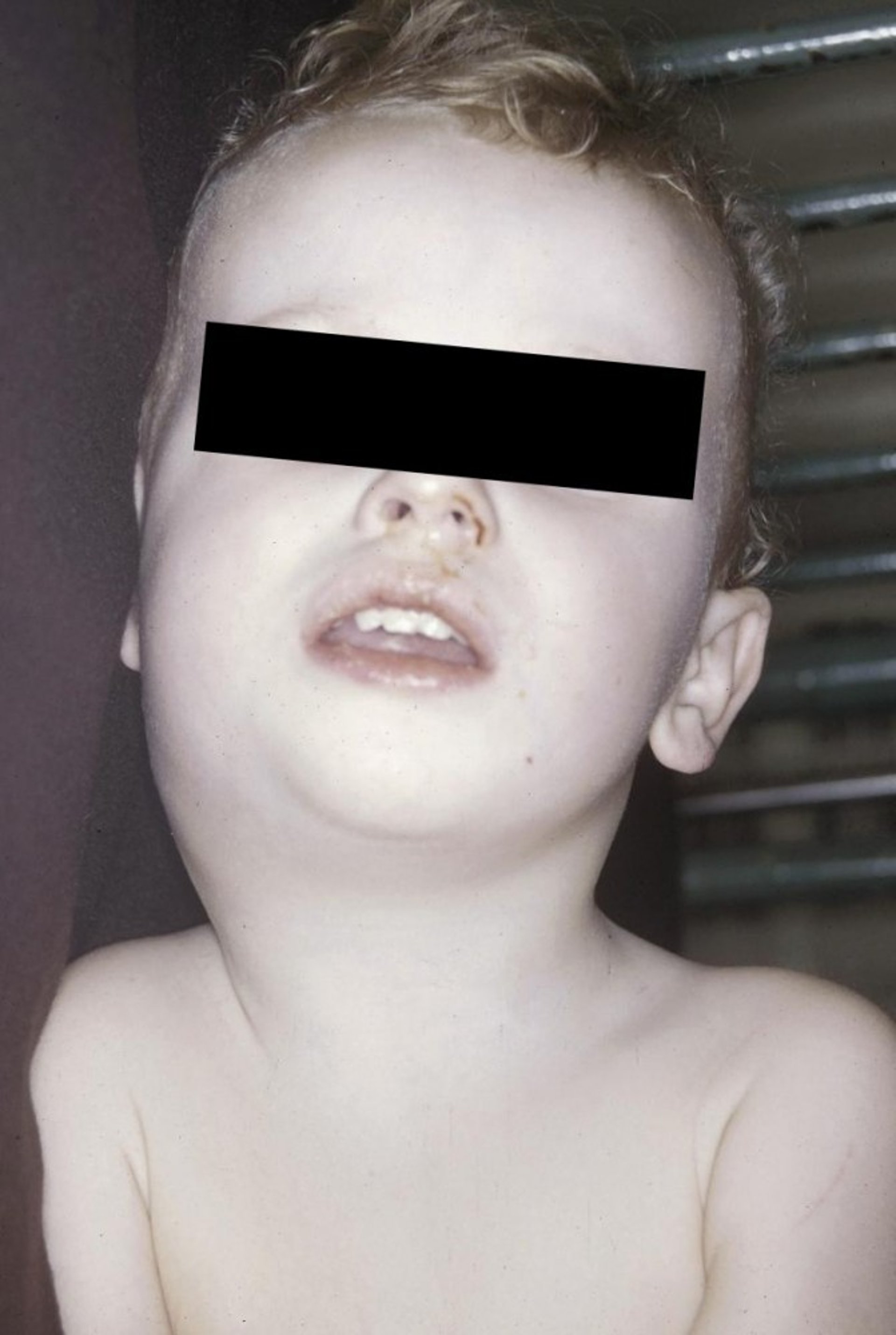
This photo shows a child with cervical swelling down to the level of the hyoid bone caused by a pharyngeal abscess.
Photo provided by Clarence T. Sasaki, MD.
Posterior space abscesses cause swelling that is more prominent in the posterior pharyngeal wall. Trismus (lockjaw) is minimal. Posterior abscesses may involve structures within the carotid sheath, possibly causing rigors, high fever, bacteremia, neurologic deficits, and massive hemorrhage caused by carotid artery rupture.
The clinical presentation often mimics peritonsillar abscess.
Diagnosis of Parapharyngeal Abscess
History and physical examination
CT
The diagnosis of parapharyngeal abscess is suspected in patients with poorly defined deep neck infection or other typical symptoms, and is confirmed by performing contrast-enhanced CT. Signs that are highly suggestive of an abscess on CT are a rim-enhancing fluid collection with central hypodensity, irregular walls, a fluid-fluid level, and the presence of internal or adjacent air (1).
Ultrasound (including point of care, transoral ultrasound) can help distinguish parapharyngeal abscess from peritonsillar abscess in selected cases (2). However, ultrasound has a lower sensitivity and specificity compared to CT (3).
Diagnosis references
1. Hagelberg J, Pape B, Heikkinen J, et al. Diagnostic accuracy of contrast-enhanced CT for neck abscesses: A systematic review and meta-analysis of positive predictive value. PLoS One. 2022 Oct 26;17(10):e0276544. doi: 10.1371/journal.pone.0276544. PMID: 36288374; PMCID: PMC9604924
2. Simard RD, Socransky S, Chenkin J. Transoral Point-of-Care Ultrasound in the Diagnosis of Parapharyngeal Space Abscess. J Emerg Med. 2019;56(1):70-73. doi:10.1016/j.jemermed.2018.09.034
3. Kalmovich LM, Gavriel H, Eviatar E, et al. Accuracy of ultrasonography versus computed tomography scan in detecting parapharyngeal abscess in children. Pediatr Emerg Care. 2012;28(8):780-782. doi:10.1097/PEC.0b013e3182627cff
Treatment of Parapharyngeal Abscess
Broad-spectrum parenteral antibiotics (eg, ceftriaxone, ampicillin/sulbactam, clindamycin)
Surgical drainage
Treatment in patients with a parapharyngeal abscess may require a combination of medical and surgical approaches as well as airway management (1). Parenteral broad-spectrum antibiotics (eg, ceftriaxone, ampicillin/sulbactam, clindamycin) are required in all patients; penicillin G with metronidazole may be an effective combination for some adult patients (2). Occasionally, small, uncomplicated abscesses can be treated with IV antibiotics alone (1).
Surgical drainage is generally needed.
Anterior abscesses can often be drained through an intra-oral incision, although larger abscesses extending beyond the parapharyngeal space may also require an external surgical approach. Several days of parenteral culture-determined antibiotics are required after drainage, followed by 10 to 14 days of oral antibiotics. Posterior abscesses can be drained externally through the oropharynx.
Treatment references
1. Page C, Biet A, Zaatar R, Strunski V. Parapharyngeal abscess: diagnosis and treatment. Eur Arch Otorhinolaryngol. 2008;265(6):681-686. doi:10.1007/s00405-007-0524-5
2. Klug TE, Andersen C, Hahn P, et al. Clinical evaluation of antibiotic regimens in patients with surgically verified parapharyngeal abscess: a prospective observational study. Eur Arch Otorhinolaryngol. 2022;279(4):2057-2067. doi:10.1007/s00405-021-06962-8
Drug Information for the Topic