A lower esophageal ring narrows the lower esophagus and is most likely present at birth.
The esophagus is the hollow tube that leads from the throat (pharynx) to the stomach. (See also Overview of Esophageal Obstructions.)
The cause of lower esophageal rings is unknown. Some may be a result of a birth defect. Some lower esophageal rings may be caused by inflammation of the esophagus due to acid reflux or pills that are not completely swallowed (pill-induced esophagitis).
Normally, the lower esophagus has a diameter of about ¾ inch (about 2 centimeters). If it is narrowed to ½ inch in diameter (about 1¼ centimeters) or less by a ring of tight tissue, the narrowing may cause difficulty in swallowing solids. This symptom can begin at any age but usually does not begin until middle adulthood. The swallowing difficulty (dysphagia) comes and goes and is especially aggravated by meat and dry bread.
Often, the ring is found when doctors look down the esophagus with a flexible tube (endoscopy) to look for reasons why people are having difficulty swallowing. Barium swallow x-rays also show the ring. In this test, people are given barium in a liquid before x-rays are taken. The barium outlines the esophagus, making abnormalities easier to see.

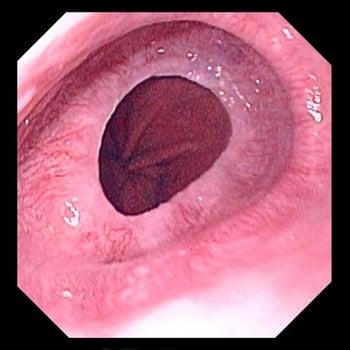
This photo shows an esophageal ring. Esophageal rings are smooth rings of mucosa (inner lining of the esophagus) that narrow the esophagus.
Treatment of Lower Esophageal Ring
Thorough chewing
Sometimes widening of the esophagus
Chewing food thoroughly followed by taking sips of water usually prevents symptoms.
A doctor may fix the narrowing by passing an endoscope through the mouth and throat and into the esophagus or may use a blunt-tipped instrument (called a bougie) to widen the passageway.
In rare cases, doctors widen the constricting ring by doing a surgical procedure.