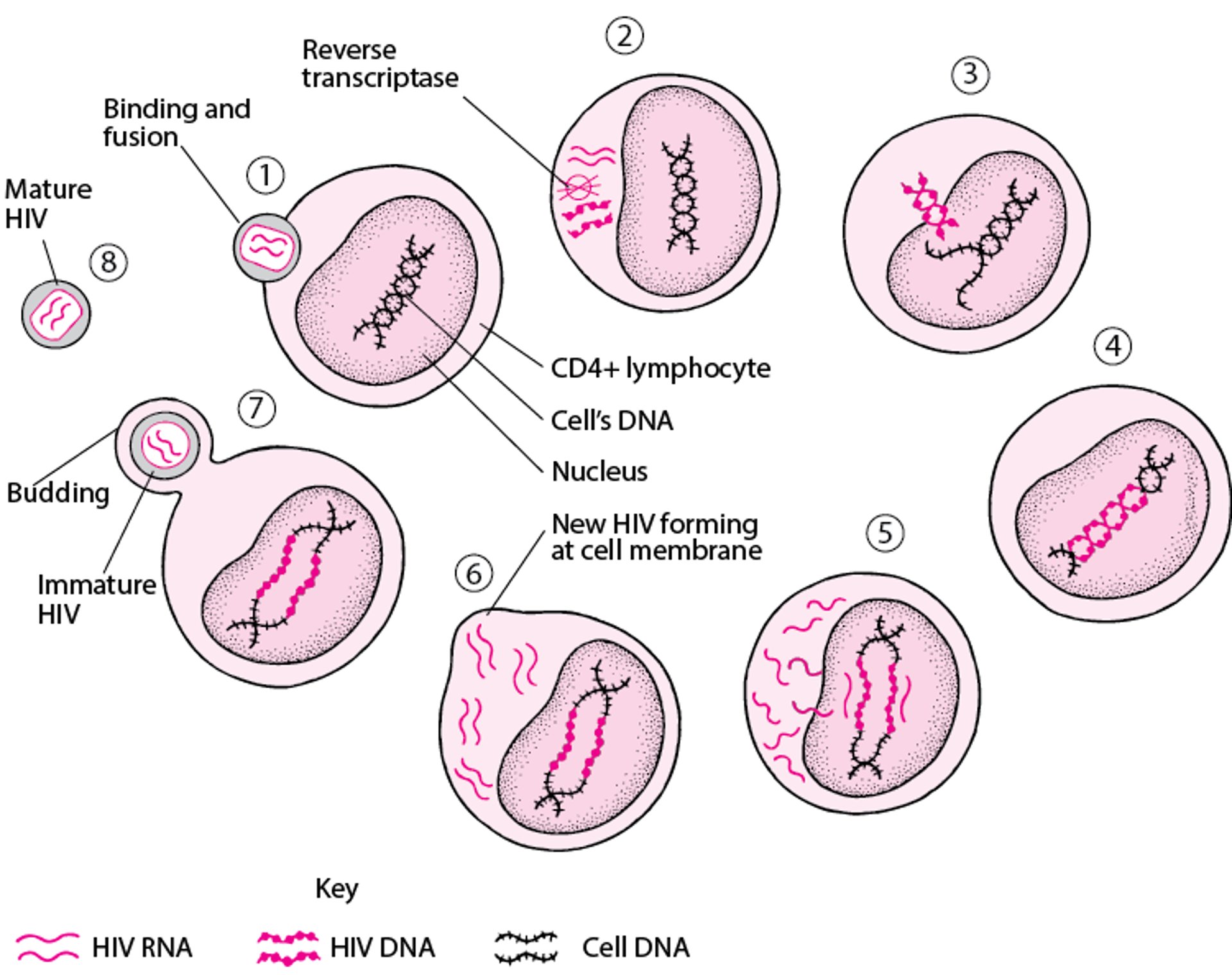
Simplified Life Cycle of the Human Immunodeficiency Virus
Like all viruses, human immunodeficiency virus (HIV) reproduces (replicates) using the genetic machinery of the cell it infects, usually a CD4+ lymphocyte.
HIV first binds to and fuses with its target cell.
HIV releases RNA, the genetic code of the virus, into the cell. For the virus to replicate, its RNA must be converted to DNA. The RNA is converted by an enzyme produced by HIV called reverse transcriptase. HIV mutates easily at this point because reverse transcriptase is prone to errors during the conversion of HIV RNA to DNA.
The HIV DNA enters the cell’s nucleus.
With the help of an enzyme produced by HIV called integrase, the HIV DNA becomes integrated with the cell’s DNA.
The DNA of the infected cell now produces viral RNA as well as proteins that are needed to assemble a new virus.
A new HIV virus is assembled from RNA and short pieces of protein.
The immature HIV virus pushes (buds) through the membrane of the cell, wrapping itself in a fragment of the cell membrane and pinching off from the infected cell. At this point, the immature virus does not cause HIV infection.
To be able to infect other cells, the budded virus must mature. It becomes mature when another enzyme produced by HIV called protease breaks up structural proteins in the immature virus, causing them to rearrange. At this point, the virus is mature and can cause HIV infection.
Medications used to treat HIV infection were developed based on the life cycle. These medications inhibit the 3 enzymes (reverse transcriptase, integrase, and protease) that the virus uses to replicate or to attach to and enter cells.