Ticks transmit other rickettsiae bacteria that cause spotted fevers similar to but milder than Rocky Mountain spotted fever.
A spotted fever develops when a tick carrying the bacteria that causes the fever bites a person.
The infection causes a fever, fatigue, muscle aches, headaches, and a rash.
To diagnose the infection, doctors do blood tests.
The antibiotic doxycycline is used to treat spotted fevers.
Avoiding tick bites is the best way to prevent the infection.
Rickettsiae are a type of bacteria that can live and multiply only inside the cells of a host organism, such as an animal or person, and cannot survive on their own in the environment. For example, hosts for rickettsiae include domestic livestock such as cows, pets such as dogs, and rodents such as mice. For most spotted fever infections, ticks are vectors (secondary hosts) that carry and spread the bacteria that cause the infection from one animal or human to another (primary host). Ticks may sometimes themselves act directly as the primary hosts without needing another animal or human (for example, Pacific Coast tick fever).


Zoonotic diseases are infections that can be naturally transmitted between animals and humans.
These diseases are caused by a variety of organisms, including bacteria, viruses, fungi, and parasites.
Some zoonotic diseases, such as rabies and cowpox, are transmitted directly from animals to people through contact with saliva, blood, urine, or feces. Others may spread through the air or through bites and scratches. In other diseases, transmission occurs through the bite of insects such as mosquitoes, ticks or fleas.
In Lyme disease, for example, deer ticks transmit the bacteria from infected carrier animals, such as mice, to humans or other animals. Insects that carry and transmit germs that cause diseases in people are called vectors.
Other zoonotic diseases, like Salmonella infection, are contracted by consuming food, water, or milk that has been contaminated by an infected animal, by consuming food that has been washed or grown in contaminated water, or by eating undercooked meat from an animal with Salmonella.
Zoonotic diseases make up more than half of all emerging infectious diseases (those that are rapidly increasing in incidence worldwide).
Zoonotic diseases not only cause illness and death in people, but also impact animal health, leading to illness in pets, zoo animals, wild animals and livestock, and reduced food availability. These diseases can have devastating effects on economies because of trade restrictions, health care expenditures, and negative effects on tourism.
Rabies is a viral zoonotic disease that is primarily spread through the bites or scratches of animals that are infected, called reservoirs. Common animal reservoirs for rabies include bats, skunks, raccoons, and foxes. Rabies spreads to the brain and spinal cord and can be fatal if not treated promptly.
Anthrax is a bacterial zoonotic disease commonly found in animals exposed to food, air, or water that is contaminated with anthrax spores. These spores can live in the environment and infect both people and animals when they are ingested, inhaled, or absorbed through open wounds. Humans may become infected through contact with infected animals or animal products that are contaminated with spores. Once inside the body, the spores develop into bacteria. The bacteria release toxins that can cause inflammation, bleeding, tissue death, and potentially sepsis.
Lyme disease is a bacterial zoonotic disease that is spread when a deer tick bites an infected carrier animal, such as a mouse, and ingests the bacteria that causes Lyme disease. The tick then bites animals or people, spreading the bacteria to them. Symptoms include fever, headache, fatigue, and a distinctive bull’s eye-shaped rash. If untreated, Lyme disease can affect the joints, heart, and nervous system.
The best way to prevent zoonotic disease is to limit your exposure to infected animals and vectors.
When contact with infected animals is necessary, it is important that you wear protective clothing and equipment like hats, gloves and glasses to avoid bites and scratches, and that you wash your hands thoroughly after handling animals.
To protect against insect vectors such as mosquitoes, ticks, and fleas, you can wear long pants and long-sleeve clothing, use mosquito netting, use insect repellents, and check for ticks after being outside in areas where they live.
It is also important to handle food safely and to avoid food that might be contaminated.
To protect animal health, keep healthy animals separate from infected animals and also protect them from exposure to insect vectors and contaminated food sources.
Copyright © 2026 Merck & Co., Inc., Rahway, NJ, USA and its affiliates. All rights reserved.
Other spotted fever infections include the following:
African tick bite fever (African tick typhus) (caused by Rickettsia africae bacteria)
Mediterranean spotted fever (boutonneuse fever) (caused by Rickettsia conorii bacteria)
North Asian tick-borne rickettsiosis (caused by Rickettsia sibirica bacteria)
Queensland tick typhus (caused by Rickettsia australis bacteria)
Rickettsialpox (caused by Rickettsia akari bacteria)
Pacific Coast tick fever (caused by Rickettsia philipii bacteria)
Rickettsia parkeri rickettsiosis

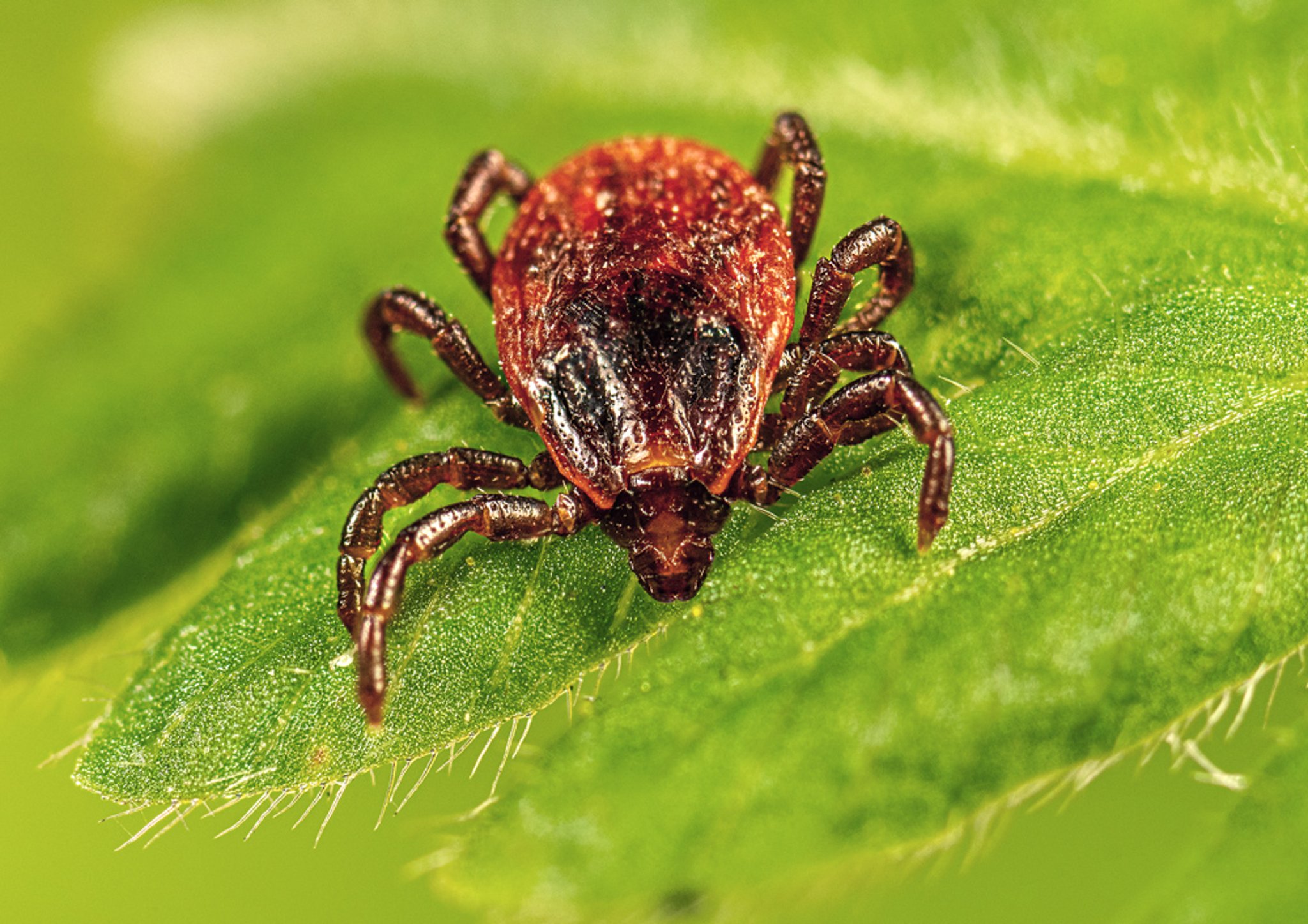
This photo shows an adult dog tick, which transmits the bacteria that cause Mediterranean spotted fever (boutonneuse fever).
CDC/Lauren Bishop
Other spotted fever infections occur all over the world (see table ). These infections occur mainly in the spring and summer, when adult ticks are active and people are likely to be in tick-infested areas. In warmer climates, the infections may occur throughout the year. For example, Mediterranean spotted fever can occur year-round in the Mediterranean region because it is transmitted by the brown dog tick and thus may be acquired indoors. (See also Ticks of Dogs.)
Symptoms of Other Spotted Fever Infections
Symptoms of spotted fever infections are similar for all of them, and they are usually milder than those of Rocky Mountain spotted fever.
About 5 to 7 days after a bite, a fever, fatigue, muscle aches, and headache develop. The eyes are red, and people feel generally unwell. A small buttonlike sore covered by a black scab (eschar) develops at the site of the bite. Usually, nearby lymph nodes are swollen. About 4 days after the fever starts, a red rash appears on the forearms and spreads to most of the body, including the palms and soles. Fever typically lasts over a week.
When appropriately treated, these infections are rarely fatal and rarely cause serious problems. Problems are more likely to occur in older adults and in people who are already very ill.
Diagnosis of Other Spotted Fever Infections
A doctor's evaluation
Blood tests
Biopsy and testing of the rash
Doctors base the diagnosis of a spotted fever infection on the person's symptoms (such as a fever, rash, and a black scab), particularly if the person has been in contact with ticks or has been in an area where spotted fevers occur.
To confirm the diagnosis, doctors may take a blood sample and do an immunofluorescence assay to detect antibodies to the bacteria. This test may need to be repeated a few weeks later to detect a rise in antibodies. Or they may take a blood sample and do the polymerase chain reaction (PCR) test to make copies of the bacteria's DNA, so that the bacteria can be detected more rapidly.
Sometimes doctors remove a sample of the rash (biopsy) and test if for antigens produced by the bacteria. See also Tests That Detect Antibodies to or Antigens of Microorganisms.
Treatment of Other Spotted Fever Infections
Antibiotics
Doctors immediately prescribe the antibiotic doxycycline if they suspect a person has a spotted fever even if test results are not yet available. The antibiotic is taken for 5 to 7 days.
Although doxycycline can cause tooth staining in children younger than 8 years old, a short, 5- to 10-day course of doxycycline in children of all ages is recommended by the American Academy of Pediatrics and can be used without causing tooth staining or weakening of tooth enamel.
Prevention of Other Spotted Fever Infections
To prevent these infections, people should take measures to prevent tick bites. (See also the Centers for Disease Control and Prevention: Preventing Tick Bites.)

If a tick is found attached to a person or a pet, it should be removed.
Use fine-tipped tweezers to grasp the tick as close to the skin surface as possible.
Pull upward with steady, even pressure, avoiding twisting or jerking motions.
Although the tick is anchored by barbed mouthparts, a slow, gentle pull will usually allow it to be removed intact.
If any mouthparts remain in the skin, leave them alone and let the skin heal on its own.
Once the tick is removed, clean the area with soap and water or rubbing alcohol.
Copyright © 2026 Merck & Co., Inc., Rahway, NJ, USA and its affiliates. All rights reserved.
Preventing tick access to skin includes:
Staying on paths and trails
Tucking trousers into boots or socks
Wearing long-sleeved shirts
Applying repellents that contain diethyltoluamide (DEET), picaridin, IR3535, oil of lemon eucalyptus (OLE), para-menthane-diol (PMD), or 2-undecanone to skin surfaces
Treating clothing, shoes/boots, and gear with permethrin
Some repellents can be toxic to children, so DEET should not be used in infants under 2 months of age, and repellents that contain more than 10% DEET should not be used in children under 12 years of age. OLE and PMD should not be used in children under 3 years of age. Permethrin on clothing effectively kills ticks. Frequent searches for ticks, particularly in hairy areas and on children, are essential in areas where infections transmitted by ticks are common.
Ticks should be removed as soon as possible. An engorged tick should be removed with care and not crushed between the fingers because crushing the tick may result in disease transmission. The tick’s body should not be grasped or squeezed. Removal is best accomplished by grasping the tick with fine-tipped tweezers as close to the skin as possible and pulling it directly out. The tick’s head, which may not come out with the body, should be removed, because it can cause prolonged inflammation. The area where the tick was attached and the hands of the person removing the tick should be disinfected with soap and water, rubbing alcohol, or hand sanitizer. Petroleum jelly, lit matches, and other irritants are not effective ways to remove ticks and should not be used.
Ticks cannot be entirely eliminated from large areas in the environment. However, the number of ticks may be reduced by taking steps to remove or prevent tick habitats and by making the environment less appealing and accessible to the animals that carry ticks. Ticks are often found in wood piles, leaf litter, tall grasses, and brush, so people can reduce the number of ticks in their yard by clearing such debris from around their home, especially outdoor play areas. Regular lawn maintenance, including frequent lawn mowing, is key to keeping ticks out of recreational areas and yards. People should remove any trash or unused furniture from their yard, and move outdoor equipment, toys, and seating away from shaded yard edges and trees. People can also install a 3-foot wide barrier of wood chips or gravel between their lawn and wooded areas.
To discourage tick-carrying rodents (such as rats, mice, and squirrels) from entering the yard, people should stack firewood in dry, elevated areas. To discourage other tick-carrying animals, such as raccoons, deer, and stray dogs, from entering the yard, people can install a fence.
Drug Information for the Topic