Sporotrichosis is an infection caused by the fungus Sporothrix.
The infection develops when the fungi enter the body through small cuts and scrapes in the skin or through bites or scratches from infected cats.
Usually, the skin and nearby lymph nodes are infected, resulting in bumps and open sores on the skin and swollen lymph nodes.
Rarely, the lungs, joints, or other parts of the body are infected.
Diagnosis requires culture and identification of the fungus in a sample of infected tissue.
Itraconazole is used to treat most infections, but amphotericin B is required for severe, widespread infections.
(See also Overview of Fungal Infections.)
Sporothrix fungi typically grow on rose or barberry bushes, in sphagnum moss, in hay, and in other mulches. In contrast to many other fungal infections, Sporothrix fungi are not usually inhaled but rather enter the body through small cuts and scrapes in the skin. Most often, infections occur in farmers, gardeners, horticulturists, and timber workers.


Sometimes people are infected by cats, particularly people in Latin America. Cats that are infected with Sporothrix can spread the fungi to people through scratches and bites. People can also become infected if they have contact with skin sores on infected cats. (See also Fungal Infections in Cats.)
Sporotrichosis affects mainly the skin and nearby lymphatic vessels. Very rarely, the lung infection pneumonia develops after people inhale spores produced by the fungus.
Also very rarely, bones, joints, the genitals, liver, kidneys, spleen, or the brain are infected, usually in people with a weakened immune system, such as those with advanced HIV infection (also called AIDS).
Symptoms of Sporotrichosis
In sporotrichosis, an infection of the skin typically starts on an arm or hand but can occur anywhere on the body. A small bump may appear on the skin, or a larger bump may appear under the skin (nodule). Either bump may slowly enlarge and form an open sore (ulcer).

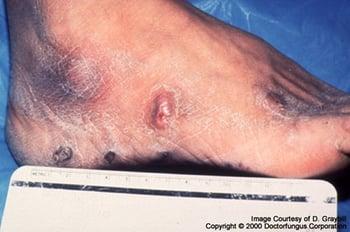
Sporotrichosis starts as a small bump that slowly enlarges and may form an open sore.
Over the next several days or weeks, the infection spreads through the lymphatic vessels of the infected area to the lymph nodes, forming more nodules along the way. Without treatment, the overlying skin becomes red and may later die, sometimes causing pockets of pus (abscesses) and open sores to form. Pus from the lymph nodes, the inflamed lymphatic vessels, or both may break through the skin, causing an opening that infected material drains through. Sporotrichosis may worsen if people develop another infection caused by bacteria. Even at this stage, people have little or no pain and usually, no other symptoms.
Sporotrichosis is fatal only in people who develop a bacterial infection that leads to a serious infection in the blood (sepsis).

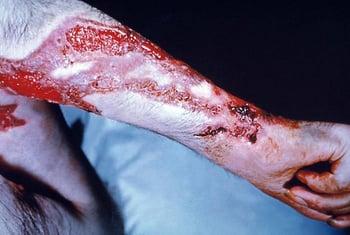
If untreated, sporotrichosis may spread along the lymphatic vessels of the infected area, causing redness, open sores, and pockets of pus (abscesses) on the skin along the way.
In this photo, open sores have been infected by other bacteria, causing more widespread infection of the skin.
Rarely, sporotrichosis does not infect the skin or lymph nodes but spreads throughout the body and infects the joints and sometimes the bones, genitals, liver, kidneys, spleen, or brain. Joint infections cause swelling and make movement painful. Such infections are life threatening and are more common among people with a weakened immune system. Pneumonia is also rare. People may have slight chest pain and cough. Pneumonia most often occurs in people who have another lung disorder, such as emphysema.
Diagnosis of Sporotrichosis
Culture of samples of infected tissue
Polymerase chain reaction (PCR) test
The characteristic nodules and sores may lead a doctor to suspect sporotrichosis, especially in people who may have been exposed to the fungus (for example, gardeners, landscapers, and foresters).


The diagnosis is confirmed by growing (culturing) and identifying Sporothrix in samples of infected tissue.
A test to identify the fungus' genetic material (its DNA), such as the PCR test, can be done on samples of infected tissue. The PCR test is used to produce many copies of a gene from the fungus, making the fungus much easier to identify.
Treatment of Sporotrichosis
Antifungal medications
People who have skin and lymph node infections are treated with itraconazole given by mouth.
If the infection is severe and widespread, amphotericin B is given intravenously until the symptoms start to go away and then they are switched to itraconazole. Treatment takes 1 year altogether.
After the infection is controlled, people with advanced HIV infection may need to take itraconazole for the rest of their life. Itraconazole helps prevent sporotrichosis from recurring while the immune system is weak.
Drug Information for the Topic